Kataban Blog
Castlevania Development History, Part 2: The Game Japan Kept and the Two That Share a Name
In Part 1, the problem was the format: a rewritable disk that shops overwrote for 500 yen. In the Super Famicom and PC Engine era the problem changes shape. One of the most sought-after entries in the series never left Japan at all, which makes the Japanese copy not the preferable one but the only one. And on the Super Famicom, Konami released two separate games whose Japanese titles are close enough that searching by name alone will not tell them apart.
- 悪魔城ドラキュラX 血の輪廻 (
KMCD3005, 1993) came out on the PC Engine Super CD-ROM² and was not released outside Japan in its original form - The Super Famicom game Konami released in 1991 (
SHVC-AD) carries the Japanese title 悪魔城ドラキュラ — the exact same title as the 1986 Famicom original and the 1993 cartridge from Part 1 - Eight rows in the Kataban catalog share that exact Japanese title across Famicom, Super Famicom, Game Boy Advance, Wii and 3DS
- 悪魔城ドラキュラXX (
SHVC-P-AZJ, 1995) is a Super Famicom remake of the PC Engine game, released in the West as Castlevania: Dracula X and Castlevania: Vampire's Kiss - Searching Suruga-ya by product code works for the PC Engine game and fails for both Super Famicom ones — the measurements are below
Why Is the PC Engine Game the One Collectors Chase?
悪魔城ドラキュラX 血の輪廻 shipped on 29 October 1993 for the PC Engine Super CD-ROM² System, under the product code KMCD3005. The CD format gave it things the cartridge entries did not have: higher-quality music via Red Book audio played from the disc rather than generated by a sound chip, and animated cutscenes in a hand-drawn anime style.
It also stayed in Japan. Giant Bomb describes it as a Japanese-exclusive entry, and it remained one until the 2007 PlayStation Portable compilation Castlevania: The Dracula X Chronicles shipped a 2.5D remake with the original game as an unlockable. The original disc version itself was not sold outside Japan until the Wii Virtual Console re-releases in North America and Europe in March 2010. For fourteen years, the only way to play it was a Japanese disc on a Japanese machine.
That single fact changes what the product code is for. Everywhere else in this series, searching by code is how you avoid buying the wrong regional version. Here there is no wrong regional version to avoid, because there is no other version. The code is not disambiguating between editions; it is just the fastest way to land on the disc.
What Do You Actually Get on the Disc?
The game progresses in a linear fashion but features many branching paths through each level, with alternate paths, secret rooms and two possible boss encounters per stage, so a single playthrough does not pass through every area. Four maidens are held in those secret rooms. One of them, Maria Renard, is behind a hidden locked door on the second stage, and rescuing her makes her a playable character who plays completely differently from Richter Belmont.
Because the audio is on the disc as CD tracks rather than being synthesised by the console, the soundtrack is identical on every machine that reads the disc. This is the opposite of the situation in Part 1, where the Famicom cartridge of 悪魔城伝説 carried a VRC6 chip and the NES release could not use it. There, the hardware decided what you heard. Here, the disc does.
Why Do Two Different Games Share One Japanese Title?
Konami released a Super Famicom Castlevania on 31 October 1991 under the product code SHVC-AD. Its Japanese title is 悪魔城ドラキュラ. That is character-for-character the same title as the 1986 Famicom Disk System original and the 1993 Famicom cartridge RV003 from Part 1. Western releases distinguish them — the Super Famicom one went out as Super Castlevania IV — but the Japanese packaging does not.
This is not a two-way collision. Searching the Kataban catalog for that exact Japanese title returns eight rows: the 1986 Famicom original, the 1993 Famicom cartridge (RV003), the 1991 Super Famicom game (SHVC-AD), a 2004 Game Boy Advance release (AGB-FADJ-JPN), two Wii entries and two 3DS entries. The four later ones are download releases and carry no product code at all.
So on the Super Famicom shelf, the Japanese title alone does not identify what you are holding. The product code does, and it is the only field in the catalog row that does.
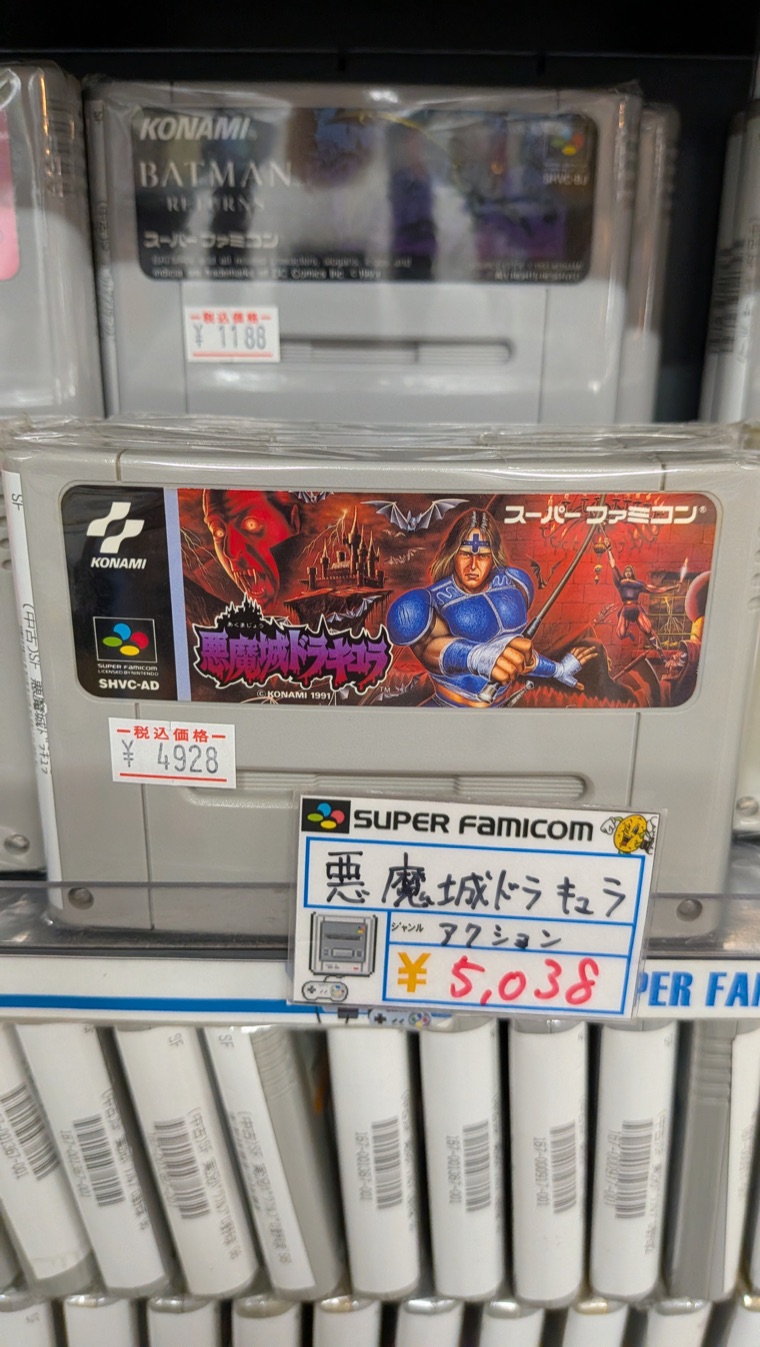
SHVC-AD at the bottom left.What Is 悪魔城ドラキュラXX and How Is It Different?
悪魔城ドラキュラXX (SHVC-P-AZJ) arrived on the Super Famicom on 21 July 1995, two years after the PC Engine game. Giant Bomb describes it as a SNES remake of Rondo of Blood that shares most of its graphics, gameplay, storyline and music, down to the sub-weapons and Item Crushes behaving as they did on the disc. It is a separate release on separate hardware with its own product code, not the same product under another name.
It went out in North America in September 1995 as Castlevania: Dracula X, and in Europe on 22 February 1996 as Castlevania: Vampire's Kiss. So this is the inverse of the PC Engine situation: 血の輪廻 had a Japanese release and no contemporary Western one, while XX has Western releases under two names that do not obviously connect back to the Japanese title.
Which Product Codes Actually Work When You Search?
The three codes in this article behave very differently on Suruga-ya. These are measured results, not assumptions.
KMCD3005 returns exactly one listing, 悪魔城ドラキュラX 血の輪廻. That is the buy link at the bottom of this article.
SHVC-AD returns 38 listings. The first one is the right game, but the rest are not: Super Donkey Kong 2, 大貝獣物語 and other unrelated Super Famicom titles appear in the same results. The code is short enough that the shop's search matches it loosely. Adding スーパーファミコン to the query does not narrow it.
SHVC-P-AZJ returns nothing at all — the search comes back as a 404 with zero results. Dropping the middle segment to SHVC-AZJ does return a single listing, but it is 全国縦断ウルトラ心理ゲーム, a different game entirely. For 悪魔城ドラキュラXX, searching the Japanese title returns seven listings and the first three are the right game, so the title is the better query here even though the code is what identifies the cartridge.
This is worth stating plainly, because the advice this site usually gives is to search by product code. That advice holds for KMCD3005. It does not hold for either Super Famicom code, and it fails in two different ways: one is too short to be specific, the other is not indexed at all.
Castlevania: Rondo of Blood · 悪魔城ドラキュラX 血の輪廻 · PC Engine · 1993 · Konami · product code KMCD3005
Where to buy: Suruga-ya.jp (by product code) · Suruga-ya.jp (by Japanese title) · Buyee
Sources
- Giant Bomb, “Castlevania: Rondo of Blood” — a Japanese-exclusive entry, PC Engine Super CD-ROM², 29 October 1993; redbook audio and hand-drawn anime cutscenes; branching paths with two boss encounters per stage; Maria Renard is rescued behind a hidden locked door on stage two and becomes playable; 2007 PSP remake with the original as an unlockable; Wii Virtual Console re-releases in North America and Europe in March 2010
- Giant Bomb, “Castlevania: Dracula X” — a SNES remake of Rondo of Blood sharing most of its graphics, gameplay, storyline and music; known in Europe as Castlevania: Vampire’s Kiss and in Japan as Akumajou Dracula XX; Japan 21 July 1995, North America September 1995, Europe 22 February 1996
- Giant Bomb, “Super Castlevania IV” — known in Japan as Akumajou Dracula; SNES, Japan 31 October 1991; an enhanced retelling of the original Castlevania with multi-directional whip attacks
- Kataban catalog (
data/master_final.csv) — eight rows carry the exact Japanese title 悪魔城ドラキュラ across Famicom, Super Famicom, Game Boy Advance, Wii and 3DS; the four later ones are download releases with no product code
This is Part 2 of a five-part series on Castlevania's development history, running through the release of the new game on October 15. Catch up on Part 1 if you missed it. Part 3 arrives on 1 October 2026.