Kataban Blog
Fire Emblem: Where It All Began — 5 Famicom & Super Famicom Games You Can Import Today
Fire Emblem is a Nintendo franchise now, with Switch entries that sell millions. It did not start that way. For the first eleven years the series never left Japan — five games came and went on the Famicom and the Super Famicom, and unless you imported them or emulated them, you simply did not play them. Marth and Roy showed up in Super Smash Bros. Melee in 2001 as characters from games nobody outside Japan had legally seen.
Those five games still exist as cartridges, and they are still on the shelves of used-game shops in Japan. This post walks through each one, gives you the product code printed on the cartridge and box, and links straight to the shops that carry them.
1. Fire Emblem: Shadow Dragon and the Blade of Light
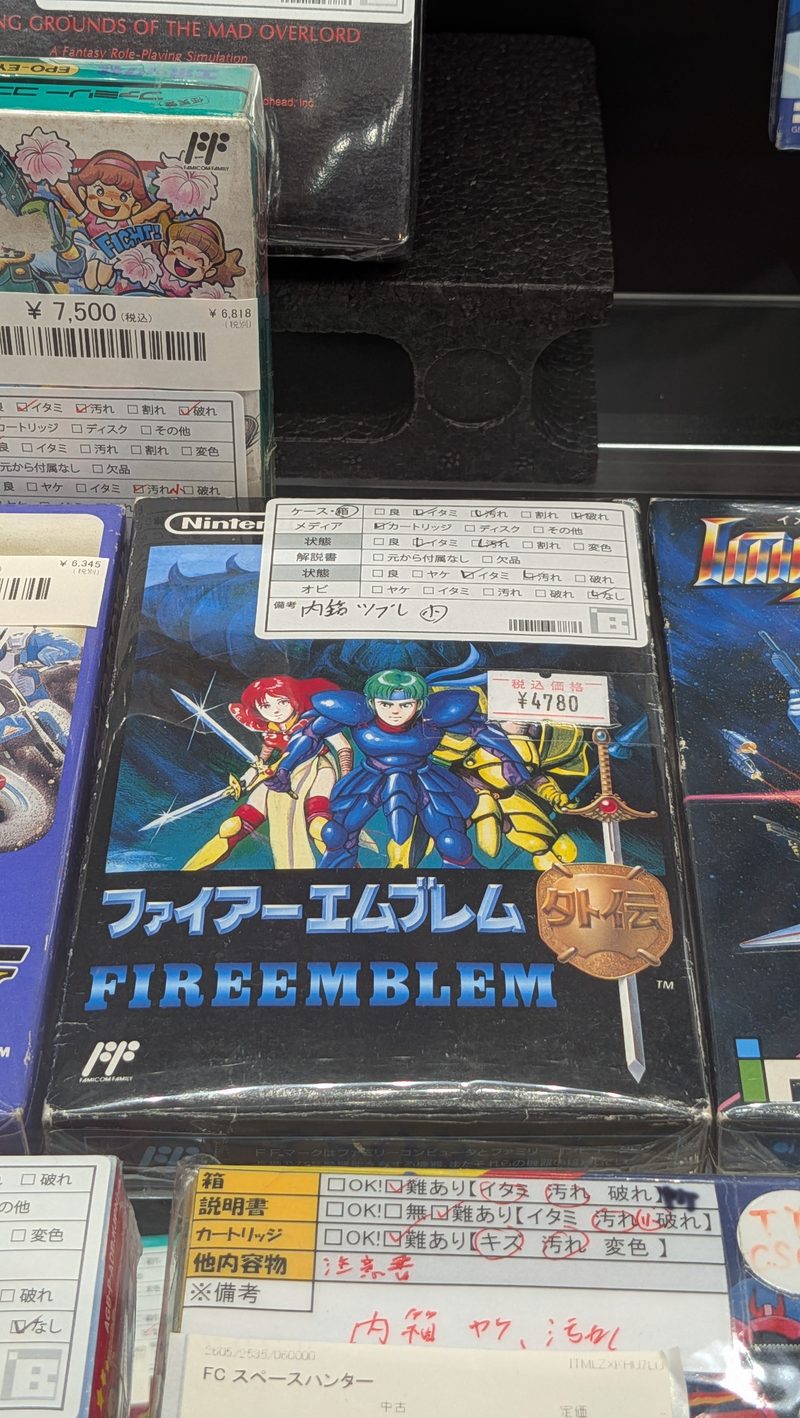
ファイアーエムブレム 暗黒竜と光の剣 · Famicom · 1990 · Nintendo · product code HVC-VX
The one that started it. Intelligent Systems put a strategy RPG on the Famicom in 1990 with a mechanic nobody else was using: when a unit dies, that unit is gone for the rest of the game. No revival, no undo. Marth's march across Archanea is the template every later Fire Emblem builds on, and the difficulty comes as much from your own unwillingness to lose anyone as from the enemy.
It stayed Japan-only for thirty years. The English release finally arrived on December 4, 2020, as a Switch download Nintendo pulled from sale on March 31, 2021 — so the Famicom cartridge is once again the most permanent copy you can own.
Where to buy:
Suruga-ya.jp (by product code) ·
Buyee ·
eBay
Search for this on Kataban →
2. Fire Emblem Gaiden
ファイアーエムブレム外伝 · Famicom · 1992 · Nintendo · product code HVC-2I
Gaiden means "side story", and this one earns the name by throwing out most of what the first game established. You move across an overworld map instead of going map to map. You walk into dungeons in a third-person view and fight random encounters. Two armies — Alm's and Celica's — advance separately on opposite sides of the continent of Valentia, and you switch between them.
It was the odd one out for twenty-five years, until Nintendo remade it as Echoes: Shadows of Valentia on the 3DS in 2017 and a lot of its ideas turned out to have been early rather than wrong. The Famicom original is the cheaper and stranger version.
Where to buy:
Suruga-ya.jp (by product code) ·
Suruga-ya.jp (by Japanese title) ·
Buyee ·
eBay
Search for this on Kataban →
3. Fire Emblem: Mystery of the Emblem
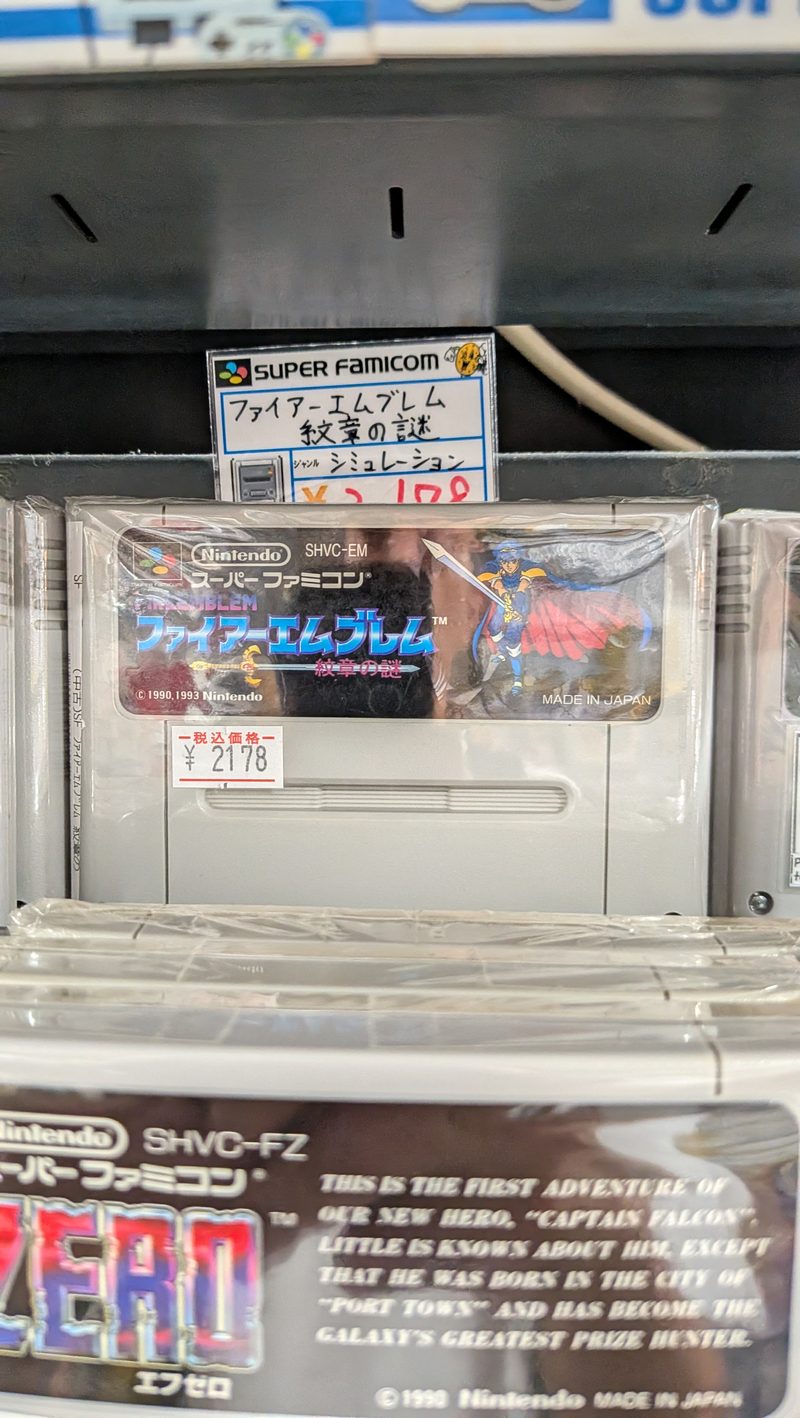
ファイアーエムブレム 紋章の謎 · Super Famicom · 1994 · Nintendo · product code SHVC-EM
Two games on one cartridge. Book 1 is a condensed remake of the Famicom original; Book 2 is a full-length sequel that picks up after it and is the real reason to buy this. The Super Famicom hardware let Intelligent Systems add the things the series is known for now — readable unit portraits, battle animations you can turn off, an interface that does not fight you.
If you only want one Marth game, this is the one to get. It is also the most common of the five in Japanese shops, which usually makes it the cheapest.
Where to buy:
Suruga-ya.jp (by Japanese title) ·
Buyee ·
eBay
Search for this on Kataban →
4. Fire Emblem: Genealogy of the Holy War
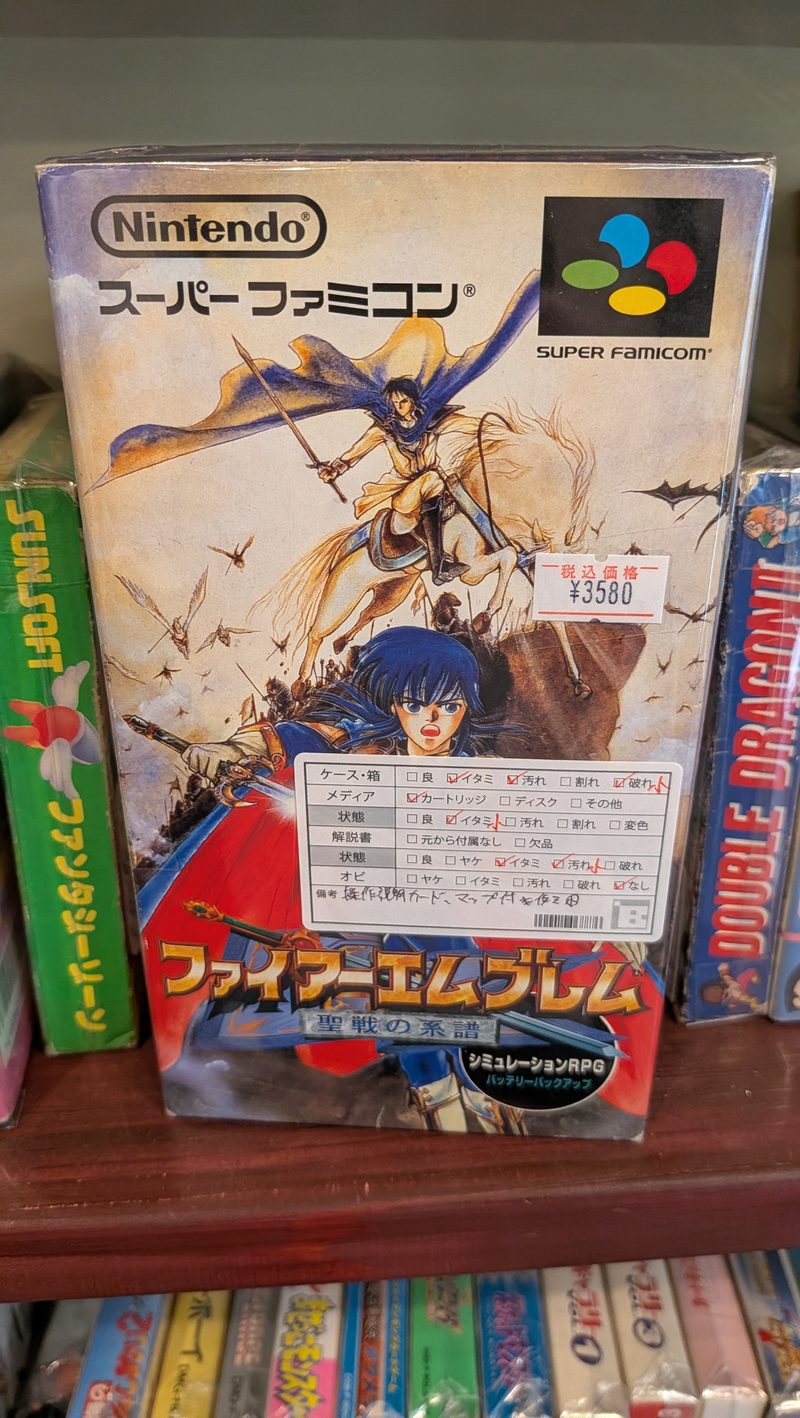
ファイアーエムブレム 聖戦の系譜 · Super Famicom · 1996 · Nintendo · product code SHVC-A32J-JPN
The ambitious one. Maps in Genealogy are enormous — a single chapter can take two hours and contains several castles you seize in sequence. Half the cast are the parents; the story jumps a generation partway through, and the children you fight with in the second half inherit stats, skills and weapons from whichever pairs you steered together in the first half. Your matchmaking in chapter 5 decides how strong your army is in chapter 9.
The plot is the darkest in the series and the one fans still argue about. It has never had an official English release in any form, on any platform.
Where to buy:
Suruga-ya.jp (by product code) ·
Buyee ·
eBay
Search for this on Kataban →
5. Fire Emblem: Thracia 776
ファイアーエムブレム トラキア776 · Super Famicom · 1999 / 2000 · Nintendo · no product code in the source data
The last Super Famicom game Nintendo published, arriving years after the console had been replaced. It fills in what Leif was doing during the generation gap in Genealogy, and it is comfortably the hardest Fire Emblem ever made: units get fatigued and sit out chapters, staves can miss, and you can capture enemies to take their equipment — at the cost of fighting at half strength while you carry them.
It shipped twice. In 1999 it went out through Nintendo Power, the cartridge-rewriting kiosk service, and in 2000 it got a normal retail cartridge with a box and manual. Kataban's data carries both records, which is why a search returns two Super Famicom entries a year apart. The retail version is the one you will actually find in shops.
Where to buy:
Suruga-ya.jp (by Japanese title) ·
Buyee ·
eBay
Search for this on Kataban →
Buying tips
Try the product code first, and the Japanese title when the code fails. The code is printed on the cartridge label and on the spine of the box — SHVC-EM, HVC-VX and so on — and for many games it is the most precise search. It does not work for every game, though. At Suruga-ya on 14 October 2026, HVC-2I returned one listing, and it was Fire Emblem Gaiden; SHVC-EM returned 11 listings for other games and none for Mystery of the Emblem, while the Japanese title ファイアーエムブレム 紋章の謎 returned seven, five of them this game (the other two were the DS remake). If a code search shows only other games, search the Japanese title instead — that is why the Suruga-ya link for Mystery of the Emblem above uses the title.
Suruga-ya.jp ships within Japan only. The links above will find you the item, but not deliver it. To receive it overseas you go through a proxy — Buyee buys it in Japan on your behalf, holds it at their warehouse, and ships it on to you. Buyee charges a flat ¥500 service fee plus Japanese domestic shipping (roughly ¥150–1,500), and international shipping is quoted once the item reaches their warehouse.
eBay is the no-proxy option, at a markup. Anything on eBay has already been exported by a seller who is charging you for having done it. It is the fastest route and usually not the cheapest. Worth checking against the Japanese price before you commit.
Learn three words of condition-speak. Japanese listings describe completeness rather than grading a disc or cartridge: 箱説付き (hako-setsu tsuki) means box and manual included, 説明書なし means no manual, and ソフトのみ means the cartridge on its own. A loose cartridge is often a fraction of the price of a complete copy, and for these five games the boxes are cardboard and did not survive well.
These carts need Japanese hardware. Famicom cartridges are 60-pin and do not fit a NES without an adapter. Super Famicom cartridges are physically blocked by the tabs in a US SNES slot, and even past that, the region lockout stops them booting. The simple answer is a Super Famicom and a Famicom, both of which import cheaply. All five games are Japanese-language only, and Genealogy and Thracia in particular are text-heavy — fan translation patches exist, but for original hardware you are playing them in Japanese.
Sources
- Product code of ファイアーエムブレム外伝: checked 14 October 2026 against a cartridge photo (archive.org) and NesCartDB; both read
HVC-2I, with the letter I. FamiWiki givesHVC-21, which is also what this guide said when first published (18 August 2026). Suruga-ya search, 14 October 2026:HVC-2I1 listing, this game; ファイアーエムブレム外伝 6 listings, 4 of them this game;HVC-2124 listings, none of them this game. - Buying tip on searching by product code, as written when this guide was published (18 August 2026):
SHVC-EMreturned the Super Famicom cartridge and nothing else, while ファイアーエムブレム 紋章の謎 also returned the Wii and 3DS Virtual Console versions (rechecked 14 October 2026 at Suruga-ya:SHVC-EM11 listings, none of them this game; ファイアーエムブレム 紋章の謎 7 listings, 5 of them this game;HVC-2I1 listing, this game).